
- All
- Product Name
- Product Keyword
- Product Model
- Product Summary
- Product Description
- Multi Field Search

Views: 0 Author: Site Editor Publish Time: 2026-05-26 Origin: Site


A mere 30-volt static shock rarely destroys an electronic component instantly. Instead, it triggers a hidden financial risk known throughout the industry as latent ESD damage. The compromised component passes initial factory quality checks perfectly. However, it suffers a drastically shortened lifespan once deployed in the field. Procurement and quality managers often face serious operational confusion when trying to prevent this specific failure mode. They frequently struggle to choose effectively between black carbon-loaded packaging and metallized silver bags. Making the wrong choice exposes businesses to severe reliability issues, complex field failures, and immense warranty claim costs. This article serves as your definitive, compliance-oriented guide. We will help you select the exact right packaging based on strict physical realities. You will understand the crucial EPA (ESD Protected Area) boundary rules completely. We will also explore rigorous ANSI/ESD standards so you can protect your valuable hardware investments with confidence.
The Core Difference: Conductive PE bags dissipate charges quickly but lack full protection from external static fields. ESD shield bags create a "Faraday cage" that completely blocks external electric fields.
The EPA Rule: Never ship sensitive components outside an ESD Protected Area (EPA) without an ESD shield bag.
The Cost of Compromise: Using a lower-tier bag for high-value components increases the risk of latent failures, leading to costly field recalls and warranty claims.
Sizing Matters: Always calculate bag size with appropriate redundancy (adding 25-50mm) to prevent physical stress on the bag's structural seams.
Up to 40% of electronic field failures stem directly from latent ESD damage. A sophisticated component might easily pass all immediate factory quality control tests. However, its internal microscopic structures suffer invisible wounds. It then fails unpredictably under normal operating stress months later. Modern micro-components rely on incredibly thin internal geometries. These miniaturized designs break down under extremely low voltages. You must understand the three distinct threat vectors to stop this latent damage effectively.
First, direct discharge physically melts internal micro-circuits. A sudden burst of localized energy permanently alters the silicon structure. Second, external electric fields cause catastrophic dielectric breakdown across highly sensitive components. These fields can induce damaging currents without any physical contact occurring. Third, tribocharging generates friction-induced static during routine handling and transit. Choosing the right ESD packaging bag goes far beyond basic material costs. It represents a critical compliance requirement governed rigidly by standards like ANSI/ESD S541. Proper compliance acts as essential risk management. It effectively protects your enterprise reputation and ensures long-term hardware reliability in demanding environments. Every stakeholder must recognize how improper packaging degrades product integrity silently.
Manufacturers create these specific bags from highly specialized carbon-loaded polyethylene. This robust construction process gives them unique and measurable electrostatic properties. The dense carbon additives form a conductive network directly throughout the plastic material itself. This structure absorbs all incoming light, rendering the material completely opaque. They feature a remarkably low surface resistance as a direct result. This resistance typically ranges strictly from 10⊃3; to 10⁵ Ω.
Such an exceptionally low resistance allows them to rapidly bleed off dangerous static charges once appropriately grounded. If a stray charge contacts the bag, the internal carbon matrix safely routes the current away. However, they carry a critical technical limitation you cannot afford to ignore. They provide only very moderate protection against external electric fields. In stringent laboratory testing, they block merely 30% of an applied static pulse. They absolutely do not act as a complete Faraday cage. External static fields can easily penetrate the material and induce charges on the enclosed components. Because of this inherent vulnerability, their best operational use case remains quite narrow. You should only use a conductive PE bag for short-distance intra-facility transfers. They work exceptionally well for moving non-critical or semi-sensitive components strictly within a fully controlled EPA. Do not let them cross the boundary into unprotected logistics areas.
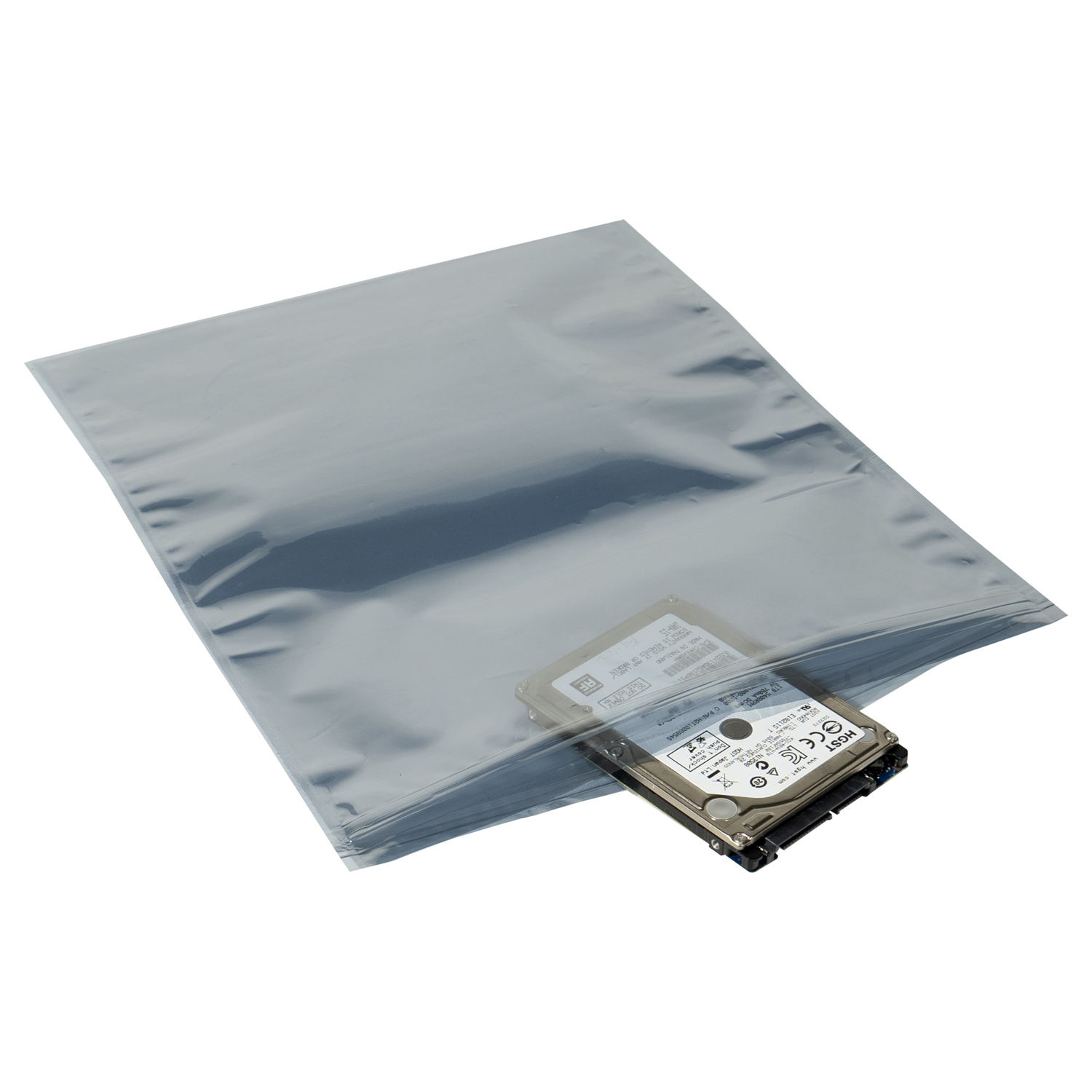
These highly specialized bags rely exclusively on a complex multi-layer architectural design. An outer static dissipative polyester layer prevents dangerous tribocharging during aggressive handling. A central metallized barrier, typically formed from vacuum-deposited aluminum or stainless steel, stops electrical penetration dead in its tracks. Finally, a low-charging polyethylene inner layer keeps the enclosed component completely safe from internal friction. Together, these three bonded layers create a robust and reliable Faraday cage effect.
Industry testing baselines confirm this architecture's impressive stopping power. A high-quality anti-static shielding bag can block up to 97% of a massive 1000V static pulse. You will typically encounter two main manufacturing styles in the commercial market: Metal-In and Metal-Out. The Metal-In configuration embeds the delicate shield safely beneath an outer dissipative layer. It is generally far more durable and cost-effective for everyday warehouse use. The Metal-Out design places the highly conductive layer much closer to the outside surface. It provides faster external discharge capabilities but wears out much faster under mechanical stress.
This complete environmental protection dictates their primary best use case. They are absolutely essential for any high-value electronic component bag leaving the safe confines of the EPA. You must deploy them for long-haul shipping applications or long-term storage scenarios in completely uncontrolled warehouse environments.
When meticulously evaluating an ESD shield bag vs conductive PE bag, their distinct performance capabilities become glaringly obvious. Conductive PE inherently offers only low to moderate shielding effectiveness against strong external fields. Conversely, a metallized shield bag provides extremely high, nearly complete Faraday cage protection. Strict industry compliance relies heavily on the rigorous ESD STM11.31 test standard. Under this demanding standard, functional shield bags must allow less than 50 nanojoules of energy penetration during an active discharge event.
Transparency presents another major operational difference for modern logistics workflows. Shield bags remain conveniently semi-transparent. This engineered clarity allows rapid barcode scanning and immediate visual QC without breaking the protective seal. Conductive PE bags remain completely opaque black. You must physically open them to verify their internal contents, which instantly breaks the controlled environmental protection. Conductive PE is generally cheaper when evaluating the per-unit material cost alone. However, the true holistic value of static shielding packaging emerges rapidly during comprehensive risk assessment. It delivers a significantly higher return on your investment by preventing catastrophic damage to high-ticket electronic components.
Performance Feature | Conductive PE Bag (Black) | ESD Shield Bag (Silver) |
|---|---|---|
Shielding Effectiveness | Low / Moderate (~30% energy block) | High / Complete (Up to 97% energy block) |
Energy Penetration Limit | Not fully rated for external field isolation | <50 nanojoules (ANSI/ESD STM11.31) |
Visual Transparency | Completely Opaque Black | Semi-transparent (Barcode readable) |
Cost vs. Value Profile | Lower unit cost for internal staging | High ROI for sensitive external shipping |
Establishing strict operational rules prevents costly packaging mistakes directly on the factory floor. We highly recommend implementing the following structured decision framework across your entire logistics network.
The EPA Boundary Rule: Inside the highly controlled EPA, you can safely use conductive PE or pink dissipative bags for non-sensitive items like installation manuals. However, the exact moment an item moves outside the EPA, employing ESD Shield Bags becomes absolutely non-negotiable.
The "Box Fill" Rule of Thumb: This represents a critical, often overlooked engineering insight. Suppose you securely enclose your primary PCB inside a silver shield bag. You must still actively manage any accompanying materials inside the outer shipping box. Enclose paper manuals, foam inserts, or extra cables in low-charging pink poly bags. This prevents severe localized tribocharging right next to your highly sensitive primary item.
Do not make the amateur mistake of buying exact-fit bags. Tight packaging places severe physical stress on welded seams. Sharp PCB corners easily puncture tense materials. This rapid physical damage destroys protective metallized layers. Use this highly reliable sizing formulation for your procurement planning:
Width formulation: Measure the Item Thickness carefully. Add the Item Width to that number. Finally, add an extra 25mm to ensure adequate physical safety margins.
Length formulation: Measure the Item Thickness accurately. Add the Item Length to that measurement. Finally, add an extra 50mm to allow for proper heat sealing processes.
Even the absolute best packaging materials fail completely if workers handle them poorly on the assembly line. The physical degradation of delicate shielding layers represents a massive hidden risk. Dry warehouse environments naturally increase tribocharging risks, making proper execution even more vital.
A common mistake on the production floor involves folding, creasing, or stapling shield bags. This aggressive physical stress instantly breaks the microscopic vacuum-deposited metallized layer. This specific damage permanently destroys the critical Faraday cage effect. You must prioritize strict verification protocols to combat this issue. We strongly outline the absolute necessity of batch-testing incoming packaging supplies upon delivery. Always verify vendor performance claims directly against documented ANSI/ESD specifications using specialized surface resistance meters.
For operational best practices, focus heavily on your standardized closure methods. Simply folding the top of the bag over and taping it remains completely insufficient. Bags must be properly heat-sealed to function correctly in the field. Heat sealers melt the inner polyethylene layers together, creating an airtight barrier. Alternatively, you can close them using a purpose-built ESD interlocking zipper. Only a complete, unbroken physical seal successfully closes the protective Faraday cage.
The strategic packaging decisions you make directly impact final product reliability and long-term customer trust. Conductive PE bags offer excellent operational utility for specific internal handling tasks. However, metallized shield bags definitively remain the ultimate industry standard for external shipping and aggressive risk mitigation. Take immediate action to secure your product lifecycles.
Audit your current shipping protocols immediately to identify hidden vulnerabilities in your outbound supply chain.
Assess systematically whether any sensitive components currently exit your EPA without proper Faraday cage shielding.
Consult directly with qualified packaging engineers to rigorously update your formal procurement spec sheets.
Invest in reliable, routine batch-testing equipment to guarantee your packaging materials continually meet ANSI/ESD standards.
A: No. Conductive bags do not provide a full Faraday cage. Once it leaves the EPA, a motherboard requires a metallized shield bag to prevent electric field penetration.
A: Pink bags only prevent the generation of static via friction; they offer zero protection against external static shocks. Silver bags prevent friction and block external static fields.
A: Look for visible scratches, deep creases, or delamination of the metallic layer. In strict compliance environments, bags should be tested with specialized resistance meters or treated as single-use for external shipping.
