
- All
- Product Name
- Product Keyword
- Product Model
- Product Summary
- Product Description
- Multi Field Search

Views: 0 Author: Site Editor Publish Time: 2026-05-18 Origin: Site


Substrate selection remains the leading cause of late-stage failure in wearable and sensor device design. You might finalize a perfect circuit layout, only to watch it snap or fail during physical user testing. Choosing between polyethylene (PE) and polyurethane (PU) dictates more than just basic signal transfer. It directly determines mechanical survival under real-world stresses.
Both polymers utilize highly engineered carbon-based conductive networks. Manufacturers blend carbon black, graphite, or advanced composite fillers into the base resin. However, these materials possess vastly different baseline properties. PU functions as an elastomer, stretching and recovering dynamically. PE behaves as a rigid thermoplastic, resisting deformation. Because of these distinct physical traits, you cannot use them interchangeably in your designs.
We will establish an evidence-based framework to help you evaluate PE carbon film vs PU carbon film. You will learn exactly how to compare them based on core mechanical requirements, biochemical resistance, and complex manufacturing compatibility.
PU Conductive Film is the baseline for high-strain, skin-contact applications (wearables, medical electrode film) due to its superior elongation and washability.
PE Conductive Film excels in static, low-cost, or chemically aggressive environments where rigid structural integrity and high moisture barriers are prioritized.
Manufacturing Trade-offs: PE strictly requires secondary surface treatments (like corona discharge) to prevent delamination of conductive inks or adhesives, whereas PU offers inherently better bonding interfaces.
Cost vs. Performance: PU carries a higher material cost but reduces downstream failure rates in dynamic use cases; PE provides economies of scale for disposable, single-use sensor arrays.
To understand performance differences, we must first deconstruct the composite structure. Any flexible electrode material operates as a highly tuned two-part system. It relies equally on its insulating polymer substrate and its dispersed conductive filler.
The substrate acts as the physical foundation. It handles the structural load, shields against environmental hazards, and provides the form factor. The conductive filler—whether composed of carbon particles, silver nanowires, or graphene—creates the internal electrical highways. The conductive network relies entirely on the substrate's integrity. It will only function until the underlying polymer undergoes micro-fracturing or severe plastic deformation.
We evaluate these substrates based on their strain tolerance baselines. Consider how these two polymers handle mechanical stress:
Elastomeric Recovery: PU possesses a natural memory. It bounces back to its original shape after stretching, ensuring the internal carbon particles remain in constant electrical contact.
Plastic Deformation: PE lacks natural elasticity. Under high tension, it stretches irreversibly. Once the polymer deforms permanently, the carbon particles separate, cutting off the electrical pathway completely.
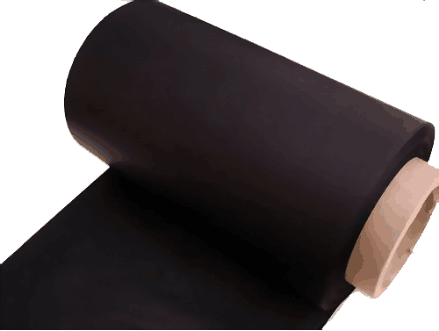
When your design requires movement, PU dominates the conversation. Its core mechanical traits center around high flexibility and multidirectional stretchability. PU conforms effortlessly to irregular topologies. It bends around joints and curves without breaking the internal carbon conductive network.
This dynamic capability explains its medical and wearable dominance. Industry leaders consider it the gold standard for ECG conductive film and transcutaneous electrical nerve stimulation (TENS) devices. Medical engineers highly value its soft texture. By utilizing a high-quality medical electrode film, developers mitigate the "foreign body sensation" in wearable tech. You can engineer PU down to ultra-thin profiles while perfectly maintaining its structural integrity against human skin.
Durability in use represents another massive advantage for PU. It boasts high tolerance to ambient moisture and human sweat. Premium PU materials confidently survive standardized wash cycles. In smart textile applications, PU networks often maintain functional conductivity after more than 100 rigorous laundering cycles.
However, PU does present specific limitations. It commands a higher material cost per square meter compared to rigid alternatives. Furthermore, continuous high-temperature exposure can degrade the polymer backbone, making it unsuitable for extreme industrial heat zones.
For scenarios demanding strict dimensional stability, PE steps forward as the superior choice. Its core mechanical traits include high tensile strength, an excellent moisture barrier, and robust chemical inertness. It resists stretching entirely. This rigidity makes it ideal for applications where physical deformation would ruin the device calibration.
Industrial and safety applications rely heavily on this material profile. Manufacturers widely use PE conductive film in disposable biosensor strips. In these environments, screen-printed electrodes require a perfectly rigid, flat surface to ensure accurate reagent reading. A bending substrate would distort the micro-printed circuit, causing inaccurate health data readouts.
PE also serves a critical safety role in Positive Temperature Coefficient (PTC) applications. Battery engineers utilize PE's specific thermal expansion properties to prevent thermal runaway. When temperatures spike dangerously, the PE matrix expands predictably. This expansion physically severs the conductive carbon networks, acting as a failsafe switch to shut down the battery cell before it ignites.
Despite its stability, PE carries strict mechanical limitations. Its poor elasticity causes the carbon coating to micro-crack if bent beyond specific, tight radii. Additionally, PE features a naturally low surface energy. This smooth, slick surface drastically complicates downstream manufacturing, requiring chemical or electrical intervention to make inks stick.
Engineers must weigh distinct trade-offs when selecting between these polymers. The following matrix contrasts their behavior across four critical product development criteria.
Evaluation Criteria | PU Carbon Film | PE Carbon Film |
|---|---|---|
Signal Integrity Under Strain | Maintains highly stable electrical impedance during continuous elongation and flexing. | Experiences sharp, immediate resistance spikes when deformed or bent past its radius. |
Biocompatibility & Comfort | Naturally breathable, highly flexible, and skin-friendly for continuous epidermal wear. | Rigid structure traps moisture against the skin, severely limiting long-term wearability. |
Chemical & Solvent Resistance | Vulnerable to aggressive solvents and harsh industrial acids. | Offers superior, robust resistance to aggressive chemicals, acids, and industrial solvents. |
Unit Economics | Justifies a premium price point for reusable or premium-grade flexible electronics. | Enables massive scale at a significantly lower price point for disposable, single-use items. |
Your operating environment dictates the winner here. PU guarantees signal integrity when the subject moves. PE guarantees chemical survival and scale when the sensor remains static.
Substrate selection fundamentally alters your production line requirements. You cannot simply drop a new film into an existing print run without addressing surface tension realities. This is known universally as the adhesion problem.
PE possesses historically low surface energy, often measuring at insufficient dyne levels right off the roll. If you apply conductive inks directly to raw PE, they will flake off. PE strictly mandates inline surface modification. Engineers typically employ Corona treatment—verified frequently by ASTM D-2578 testing—to combat this. Corona discharge temporarily ionizes the PE surface, creating microscopic anchor points. This prevents the catastrophic delamination of subsequent conductive layers or medical adhesives.
Coating and printing compatibility also differs heavily. Screen printing conductive pastes onto PE requires incredibly precise curing temperature control. If your drying oven runs too hot, the PE substrate will warp and ruin the batch. Conversely, PU conductive film integrates seamlessly with advanced roll-to-roll coating systems. The porous nature of PU allows for interlocking interfaces with applied inks, dramatically reducing electrical contact resistance.
To implement proper risk mitigation during scale-up, follow these precise steps:
Run localized current hot-spot testing: Conduct pilot runs to map electrical resistance across the entire film web. This prevents localized current spikes, which can cause patient burns in wearable medical devices.
Verify contact resistance post-compression: Always measure the impedance of the film after it passes through the compression rolling phase. Pressure can alter the density of the carbon network.
Test surface energy hourly: If running PE, verify your Corona treater output constantly. Surface energy drops quickly, and treating failures will ruin entire material batches.
Your substrate dictates your product's ultimate success in the field. Choose PU if the product moves, bends, or lives extensively on human skin. Its elastomeric properties guarantee safety and comfort. Choose PE if the product remains stationary, functions as a disposable diagnostic tool, requires a strict chemical barrier, or acts as a rigid thermal safety switch in battery packs.
Before requesting bulk material samples, accurately audit your product's maximum expected strain percentage and exact operating environment. Quantify your acceptable stretch limits. If your use case sits squarely on the borderline of "semi-flexible," prototype immediately with both materials to test real-world impedance changes under load.
A: Only in localized, rigid sensor housings. For continuous skin contact requiring flex, PU or silicone is required to prevent sensor detachment and signal noise. PE cannot adapt to the natural stretching of human skin, which leads to immediate mechanical failure and distorted data readings.
A: Gradual degradation occurs, but medical-grade PU films engineered with multi-dimensional carbon/silver networks can maintain functional conductivity for approximately 100 standard wash cycles. You must pair them with appropriate encapsulating adhesives to maximize this lifespan during consumer use.
A: PE is chemically inert. Corona treatment temporarily ionizes the surface, raising its surface energy to ensure that subsequent conductive coatings or medical-grade hydrogels bond without flaking. Without this critical electrostatic discharge step, your printed circuit will simply wipe off the substrate.
